
AI compliance Services with Deep Privacy Expertise

Make your AI system EU-market ready in 4 weeks.
Full compliance documentation for seamless sales operations, due diligence and ISO 42001 implementation.
- AIGP Certified multilingual experts
- Deep AI-tech knowledge
- €2,000,000 Professional Indemnity Insurance by Hiscox
You have...
until High Risk Systems requirements will come into force.

This might be you
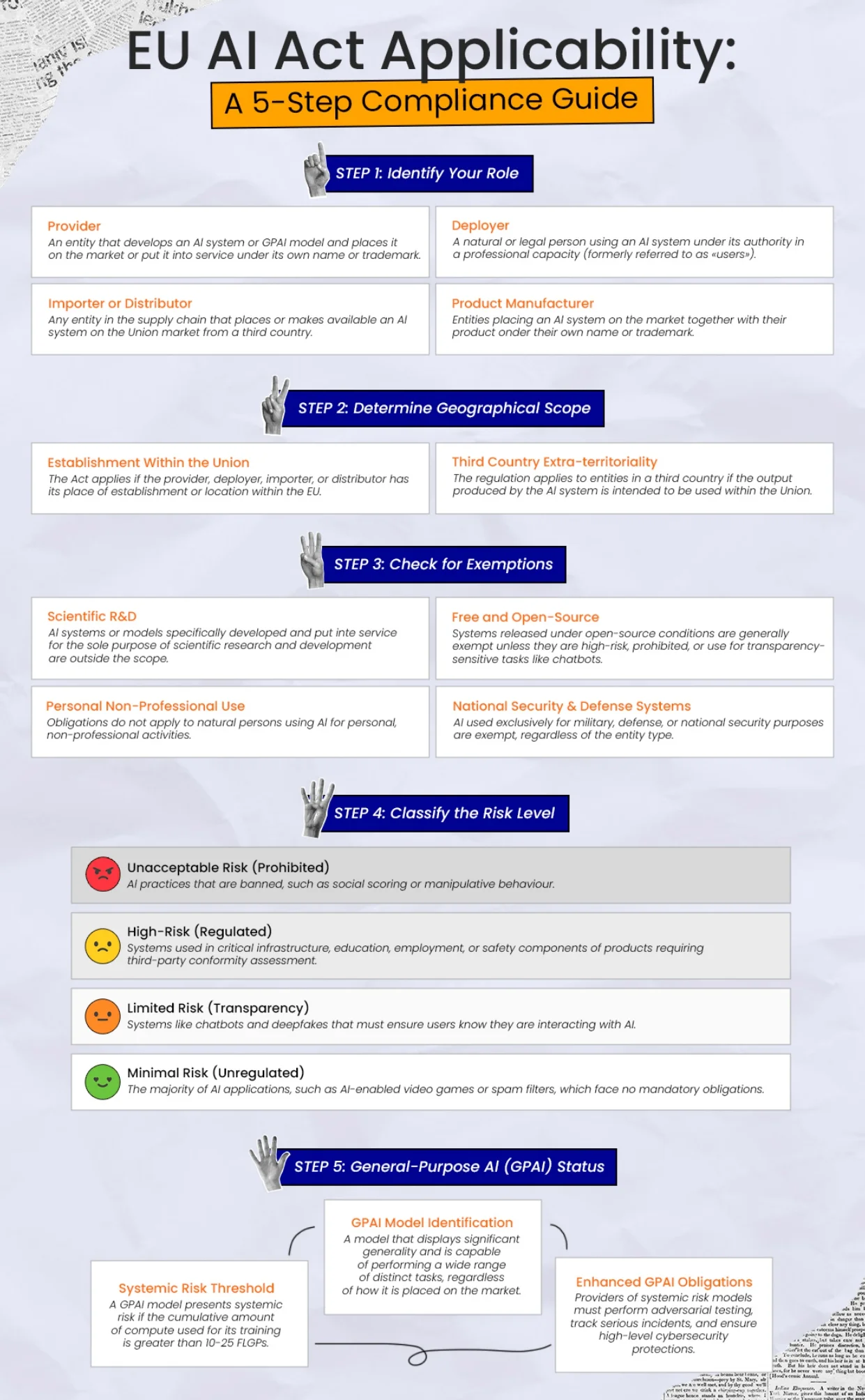
Who the EU AI Act does apply to?

Providers
These are organizations that develop an AI system (or commission its development) and place it on the market under their own name.
Examples of systems
- Industrial efficiency: Software from General Electric helping factories monitor and reduce resource consumption (electricity, gas, water).
- Transportation and safety: Mobileye technologies providing driver assistance features (automatic braking, lane keeping) for various automotive brands.
- Financial services: Fraud detection systems from Mastercard.
Deployers
These are individuals or organizations using an AI system in their professional capacity (does not apply to personal, non-professional use).
Examples of systems
- Insurance: Companies (e.g., Allianz) using AI to automate claims processing, such as the “60-second payout” process.
- Retail and cosmetics: Brands (e.g., Charlotte Tilbury or Max Factor) offering customers virtual makeup try-on or skin diagnostics services using third-party AI solutions.
- Public sector and law enforcement: Police or border services using biometric identification systems or crime risk assessment tools.
Importers
These are EU-based entities that first introduce an AI system from a non-EU provider onto the European market. They are required to ensure that the provider has completed all conformity assessment procedures and prepared the necessary documentation.
Examples of systems
- Specialized software providers: A European legal entity that procures an AI system from a developer in the USA or China (without an office in the EU) for subsequent sale or provision to companies within the European Union.
- System integrators: A European consultancy that licenses an AI-powered analytics tool from a non-EU vendor and resells it as part of its service offering to EU clients.
Distributors
These are entities in the supply chain that make an AI system available on the EU market without being the provider or the importer. They must verify the presence of CE marking and accompanying documentation before making the system available.
Examples of systems
- Cloud platforms and marketplaces: Services such as AWS Marketplace or Google Cloud Marketplace that make AI models already placed on the EU market available to end users through software libraries or APIs.
- IT resellers: Value-added resellers (VARs) that distribute AI solutions from established providers to enterprise customers across the EU.
If you represent a group of companies, your structure may include both deployers and providers. And each must comply with their obligations.
Our team
We combine legal precision with deep technical fluency. From building compliance systems from scratch to defending clients before regulators — we deliver under real business pressure.




















Learn how our compliance services are delivered
Phase 1: AI Inventory and Risk Mapping
- Complete inventory of AI systems across departments and geographic regions.
- Documentation of functionality, input data, output data, and level of autonomy.
- Risk classification according to the EU AI Act (high risk, transparency risk).
- Centralized registry, including third-party AI integrations.
- Assignment of internal compliance tracking owners.

Provider Track
- Documentation templates, written policies and instructions, risk management (i.e., list of known and reasonably foreseeable risks, conformity assessment procedure specification, etc.).
- Conformity assessment process for high-risk systems.
- Clear ownership policy: who creates, who approves, who signs.
Deployer Track
- Privacy Notice updates for AI transparency.
- Acceptable Use Policy (AUP).
- Human oversight policy with escalation protocols.
- Monitoring system and incident reporting procedures.
- Data quality validation.
- Record-keeping system for audit readiness.
- Staff training program.
Phase 2: Provider and Deployer Obligations
Phase 3: Governance and Control
- Role clarification and licensing agreement updates.
- Distribution of responsibilities and obligations across legal entities.
- Designation of European legal entity for regulatory accountability.
- Bias detection procedures and fairness audit framework.
- Ongoing post-deployment compliance checks for your AI.
- Acceptable use policy for internal AI tools.
- DPIA template review and AI-specific updates.
- Vendor and external AI tools compliance checklist.
Our track record in numbers
GDPR experts who understand AI Act. AI Act experts who understand GDPR.
220+
completed projects
from early-stage startups to multinational corporations
49
jurisdictions
EU, UAE, Latin America, APAC, MENA
Zero
compliance failures
no client has faced regulatory action post-engagement

Included in the base price
- Up to 5 AI systems, one jurisdiction
- Additional systems: €1,200 each
- Multi-jurisdiction add-on: +€2,500
Choose your package
Startup Fast-Track
- Fixed price: €9,900
- Timeline: 4-6 weeks
- Best for: Seed-Series B, up to 5 AI systems
Deliverables:
- AI system inventory and risk classification
- Gap analysis with 90-day remediation plan
- Template kit: AI DPIA, Risk Register, Transparency Notice, Incident Guidance
- Provider/Deployer role determination
- 2 workshops (kickoff + findings review)
- One-pager for enterprise sales

Startup Premium
- Fixed price: €14,900
- Timeline: 4-6 weeks
- Best for: Pre-Series A/A, preparing for fundraising
Everything in Fast-Track, plus:
- Investor due diligence pack (Q&A, compliance deck)
- Term sheet compliance clause review
- 6-month post-delivery support
- Board-level compliance summary

Enterprise Standard
- Fixed price: €24,900
- Timeline: 8-10 weeks
- Best for: 5-10 AI systems, up to 2 jurisdictions
Includes everything in Startup Fast-Track, plus:
- Multi-jurisdiction role mapping (Provider/Deployer/Importer per legal entity)
- Regulator-ready technical documentation package
- SDLC-embedded controls (Jira, GitHub/GitLab, Azure/AWS/GCP)
- Bias testing and fairness audit procedures
- Post-market monitoring framework
- Role-based training (developers, product, legal, executives)
- Compliance provisions in licensing agreements
Enterprise Premium
- Fixed price: €39,900
- Timeline: 10-12 weeks
- Best for: 11-20 AI systems, 3+ jurisdictions
Everything in the standard version, plus:
- GPAI (General Purpose AI) compliance analysis
- Multi-entity liability structuring
- Cross-border data flow mapping
- Advanced conformity assessment procedures
- Executive steering committee facilitation
- Regulatory engagement support (if required)

Not sure which package you need?
Request a free consultation with our AI compliance expert. During the meeting, they’ll determine the approximate number of AI systems and applicable requirements based on your business plan. After the consultation, you’ll receive a follow-up with possible next steps for compliance.


Learn our cases




- AI/ML
- Enterprise


Here’s what our clients say about our services

Co-founder & COO
On behalf of GoingGlobal.io, we thank DPO Europe for their excellent service. The consultant responsible for our request met all deadlines and delivered a Record of Processing Activities and a Privacy Policy for our website. Throughout the engagement, the team stayed in touch, promptly answered our questions, and suggested next steps to support our business. We wish DPO Europe continued success and look forward to working together again.
Learn more…
Data Privacy Specialist
Talent Nations is entering the UAE market and engaged Data Privacy Office to launch personal data protection. The team professionally prepared the register of processing procedures and policies and stayed in touch, promptly answering our questions. We are satisfied with the results and will apply them in our project. We wish Data Privacy Office continued success in this complex field of personal data protection.
Learn more…
VP of Oxagile LLC
Oxagile LLC expresses gratitude to the international training and consulting company Data Privacy Office for services for the initial implementation of GDPR. The team conducted detailed data mapping through interviews with external project participants and department representatives. We highly appreciate the quality and benefits of the services and look forward to further cooperation with Data Privacy Office.
Learn more…
Data Privacy Specialist
The course is well-structured and well-presented. I’m very happy with Petruta Pirvan as a trainer. She has extensive knowledge of the subject and explains things clearly and concisely, even for beginners. I think I was generally very happy with the structure of the training and the approach to the EU AI Act, including the cross-references to national-level contexts. Some of the students also brought valuable insights from their own national jurisdictions. Both theory and practice had a good balance. I would not say at all it was superficial.
Learn more…
Privacy Officer
I had seen many courses on AI for other industries, but none specifically for data protection. When I found this course, it was a real eye-opener. Additionally, the course doesn’t just focus on the benefits of AI but also addresses its risks, providing valuable insights on how to use AI safely and effectively in our field.
Learn more…
DPO Consultant
I really enjoyed this course. It showed me how to integrate AI into the daily tasks. Siarhei explains everything clearly and with humor, and it’s obvious that he has extensive experience in consulting. The practical examples were particularly valuable. The course provided a solid foundation and practical insights into how AI can be used in everyday work, which I’m excited to start implementing as I move forward.
Learn more…
Compliance Manager
I’m not a techie, and honestly, I was worried that the course would be overloaded with complicated tools. The n8n module was definitely the hardest part, but Siarhey explained everything step by step, and eventually, it all clicked. Otherwise, everything was fantastic — lots of concrete case studies, real-world examples of how to apply AI in tasks like DPIA analysis and handling subject access requests.
Learn more…
Data Privacy Officer
Everything Siarhei covered was focused on practical application: how to use the tools, how to write effective prompts, and where automation really makes a difference. Some parts were challenging, especially if you’ve never worked with integrations, but after a few tries, it all clicked. I’ve already automated part of my reporting process and saved a ton of time.
Learn more…
Senior Data Protection Consultant
AI4DPO turned out to be the most hands-on course I’ve taken in recent years. There was no unnecessary theory, it was all about practical application. The best part for me was learning how to use AI for report generation and checking policies for GDPR compliance. Siarhei deserves special mention since he doesn’t just teach, he shows you how a professional thinks when combining legal expertise with technology.
Learn more…
Among the many merits of the program, I would like to highlight the following: extensive experience in the field of privacy protection and high professionalism of the trainer Siarhei Varankevich, teaching talent combined with maximum involvement in the educational process, organization of training in small groups, well-thought-out training format, volume and quality of the provided additional materials and constant organizational support.
Learn more…
Typical business problems we solve per consultancy project
Transparency gaps
Chatbots and automated messages generating synthetic content without labeling, detection, and disclosure.
Role uncertainty
One legal entity registered as a Provider while others act as Deployers.
High-risk edge cases
AI affecting employment may fall under Annex III, but exceptions for narrow tasks often nullify this.
AI Governance gaps
Lack of proper assessments (i.e., risk assessments, fundamental rights impact assessments, DPIAs, etc.), do’s/don’ts checklists, Acceptable Use Policies (AUPs), templates, weak awareness, etc.
If you need to
We will
If you need to
Hold a corporate pilot or investor due diligence.

We will
Deliver compliance documentation ready for investor review and corporate partnership approval within weeks.
If you need to
Close a B2B deal.
We will
Provide audit-ready evidence packages that satisfy B2B clients’ procurement and legal requirements.
If you need to
Take into account all complex business requirements.
We will
Map all AI systems with the company’s role structure, take into account all necessary standards, including ISO 42001, ISO 27001, NIS2, and build compliance in accordance with the required jurisdictions, for example, EU, Latin America, MENA, APAC.
What makes our AI compliance services special?
We implement, not just advise
Our consultants have built compliance systems from scratch, not just reviewed them.
We speak both legal and technical
Our team includes ex-developers who understand ML pipelines, data flows, and API integrations.
We've been in the trenches
From handling mystery shopping audits to defending clients during supervisory authority inquiries, we know what real compliance looks like under pressure.
We guarantee the result
Evidence package by week 4 (Startup) or week 8 (Enterprise) — or free extension until completion.
Post-delivery support
If a regulator requests additional documentation within 90 days, we’ll provide it free of charge.
Deal protection
100% money-back guarantee if you lose a corporate deal due to incomplete compliance materials we provided.
EU AI Act Implementation Timeline (2024-2030)
The EU AI Act officially became law in July 2024, with its requirements being introduced in phases to allow for a smooth transition. In February 2025, the first regulations took effect, focusing on banning AI systems that pose unacceptable risks. By August 2026, the majority of the law’s rules will apply to most AI technologies and providers. Finally, certain specialized systems and large-scale projects have until 2027 or even 2030 to meet all legal standards.
2024
EU AI Act published and enters into force; compliance requirements not yet mandatory.
- July 12, 2024: The AI Act is published in the Official Journal of the EU.
- August 1, 2024: The Act enters into force. While the law is officially "active," the requirements are not yet mandatory (Article 113).
- November 2, 2024: EU Member States must identify and list authorities responsible for protecting fundamental rights (Article 77(2)).
2025
Prohibited AI systems banned; GPAI rules and AI governance framework take effect.
- February 2, 2025: Bans on Prohibited AI systems (e.g., social scoring, specific biometric systems) start to apply. Requirements for AI literacy for staff also become mandatory. (Article 113(a), Recital 179)
- May 2, 2025: Deadline for the Commission to have "Codes of Practice"Ю ready to help developers comply with the rules. (Article 56(9))
- August 2, 2025: Several major chapters begin to apply:
- General-Purpose AI (GPAI) Models: Rules for GPAI providers become mandatory. (Article 113(b))
- Governance & Penalties: New structures for oversight and rules for fines and penalties take effect. (Chapter VII, Articles 99-100)
- Member State Obligations: Countries must designate their national authorities and report on their financial/human resources. (Article 70(2, 6))
- Existing GPAI: Providers of GPAI models already on the market before this date have until August 2027 to comply. (Article 111(3))
2026
High-risk AI systems deadline; AI regulatory sandboxes operational across EU.
- February 2, 2026: The Commission must provide detailed guidelines on how to implement rules for High-Risk AI systems and post-market monitoring. (Articles 6(5), 72(3))
- August 2, 2026: The bulk of the AI Act becomes applicable. (Article 113)
- High-Risk Systems: Rules apply to operators of high-risk systems placed on the market before this date only if they undergo significant design changes. (Article 111(2))
- Regulatory Sandboxes: Every EU country must have at least one operational AI Regulatory Sandbox to help companies test AI safely. (Article 57(1))
2027
Final GPAI compliance deadline; high-risk AI classification rules apply.
- August 2, 2027: The specific high-risk classification rules under Article 6(1) (systems that are products or components of products subject to EU safety laws) become applicable. (Article 113)
- August 2, 2027: Deadline for all existing GPAI models (those available before August 2025) to be fully compliant with the Act. (Article 111(3))
2028
AI Act evaluation: AI Office, voluntary codes, and high-risk categories reviewed.
- August 2, 2028: The Commission performs several major reviews:
- Evaluating the performance of the AI Office. (Article 112(5))
- Assessing the impact of voluntary codes of conduct. (Article 112(7))
- Reviewing the need for changes to High-Risk categories (Annex III) and transparency rules (Article 50). (Article 112(2))
- Reporting on the energy efficiency of GPAI models. (Article 112(6))
- December 1, 2028: The Commission must report on its delegated powers to ensure the law remains up to date. (Article 97(2))
2029
AI Act implementation report; Commission’s delegated powers expire unless extended.
- August 1, 2029: The Commission’s specific powers to adopt new rules (delegated acts) will expire unless the EU Parliament or Council decides to extend them. (Article 97(2))
- August 2, 2029: The Commission submits a major evaluation and review report of the entire AI Act (this will happen every four years). (Article 112(3), Recital 174)
2030
Public authority AI compliance; large-scale IT systems final deadline (Dec 31).
- August 2, 2030: Public authorities using high-risk AI systems must be fully compliant with all rules and obligations. (Article 111(2))
- December 31, 2030: This is the final deadline for large-scale IT systems (like those used for border control or justice, listed in Annex X) to meet the requirements of the Act. (Article 111(1))
What are the requirements?
Unacceptable Risk Systems Provider
Banned for usage.
High-Risk Systems
- Establish a risk management system throughout the entire AI lifecycle.
- Implement data governance to ensure representative, error-free training datasets.
- Prepare detailed technical documentation.
- Provide clear instructions for use.
- Enable human oversight capabilities.
- Meet standards for accuracy, reliability, and cybersecurity.
- Complete conformity assessment and obtain CE marking before market entry.
Limited Risk
- Inform users that they are interacting with AI.
- Label artificially generated content.
Low Risk
Voluntary compliance with codes of conduct is encouraged.
- Use systems strictly in accordance with the provider's instructions.
- Ensure human oversight by qualified personnel.
- Monitor system operation and store logs generated automatically by the system.
- Inform the provider or distributor of any serious incidents or malfunctions.
- For certain organizations (e.g., public authorities) conduct a Fundamental Rights Impact Assessment (FRIA) before using high-risk systems.
AI Literacy is required under Article 4 of the EU AI Act for both Deployers and Providers.
Companies must train employees who work with AI so they understand the risks and opportunities of this technology. The business must also be able to provide evidence of training completion, such as passed tests or certificates.
We provide interactive LMS-friendly trainings for all employees that require only 45 minutes to complete.
Build Responsible AI Systems
From EU AI Act documentation to staff training and embedded SDLC controls, we build compliance that stands up to regulators, satisfies investors, and closes enterprise deals.
Fill in the form and get a free consultation.

Make a preliminary assessment of your AI systems
Download our free AI Compliance Checklist to learn the steps you need to take to reach compliance.






Frequently Asked Questions
Is GDPR compliance the same as meeting the regulatory requirements of the Artificial Intelligence Act?
No, they are distinct but overlapping regulatory frameworks. While GDPR compliance focuses on the protection of personal data, the Artificial Intelligence Act introduces a broader governance framework for the development and use of artificial intelligence based on risk levels. But still the main principles of people’s privacy rights as transparency and bias absence are the same for both regulations. Our services leverage deep data protection expertise to ensure your organisation meets both sets of regulatory obligations.
How fast can you perform an audit and make our organisation compliant with regulatory expectations and aligned with best practices?
We can make you audit-ready for stakeholder reviews, procurement, and regulatory compliance within 4 to 12 weeks, depending on the chosen package. For example, the Startup Fast-Track takes 4–6 weeks to deliver a complete inventory and gap analysis. We provide proactive expert guidance to speed up your ai adoption and satisfy regulatory expectations.
Can we implement AI regulation requirements ourselves, or do we need compliance support to tailor our risk management?
While an organisation can attempt internal implementation, the regulatory landscape is complex and requires tailored solutions to mitigate risks associated with artificial intelligence. We provide tailored support to embed trustworthy AI principles into your organisational processes. Our team helps you draft technical documentation and policies that ensure adherence to global data standards.
What outcomes and deliverables will our organisation receive to ensure regulatory compliance?
At the end of the project, you receive a comprehensive governance framework, including an audit-ready AI system inventory, risk classification, and a remediation plan. Deliverables also include a template kit (AI DPIA, Risk Register, Transparency Notice) and executive-ready evidence packages for investor due diligence or enterprise sales.
Can your compliance support cover third-party AI tools?
Yes, we include third-party AI integrations and vendors in our inventory and risk management mapping. We provide a specific vendor and external AI tools compliance checklist to ensure that your use of artificial intelligence remains responsibly managed across the entire organisation.
How do you handle a complex organisation with multiple entities and deployer vs provider roles?
We map all artificial intelligence systems against your company’s organisational structure. We clarify regulatory roles (Provider, Deployer, Importer) for each legal entity and distribute regulatory obligations accordingly, ensuring sector-specific adherence to the Artificial Intelligence Act.
Can you embed AI regulatory controls directly into our AI development workflow?
Yes, our Enterprise Compliance Sprint is designed to embed controls directly into your SDLC and tools like Jira, GitHub/GitLab, and cloud environments (AWS/Azure/GCP). This ensures that ensuring compliance becomes a scalable and automated part of your development and use of artificial systems.
Do you include AI literacy training and evidence that our staff completed it?
Yes, Article 4 of the Act requires organisational AI literacy. We provide interactive, LMS-friendly training for employees. To meet regulatory requirements, we provide evidence of training completion, such as certificates or passed tests, to demonstrate responsible ai governance. Learn more about our training programs here.
How does pricing work regarding the number of artificial intelligence systems and jurisdictions?
Our base pricing covers up to 5 AI systems and one jurisdiction. We offer scalable add-ons for additional systems (€1,200 each) and a multi-jurisdiction add-on (+€2,500) to support your global data ai strategy.
What makes your compliance support different from a typical legal firm?
Unlike traditional firms, we provide expert guidance that combines legal audit requirements with technical deployment expertise. We don’t just provide a draft of a policy; we help you mitigate real-world risks through bias testing, fairness audits, and SDLC integration, ensuring your ai development is both responsible and compliant.
What compliance support is available for mitigation if a regulator asks questions after the lifecycle of the project?
We provide post-delivery support to help you responsibly handle follow-up inquiries. If a regulator requests documentation within 90 days of project completion, we provide it free of charge. Some packages also include up to 6 months of ongoing proactive support.
Which package should we choose to tailor our AI strategy?
- Startup Fast-Track: Best for Seed-Series B companies with up to 5 systems needing a quick regulatory gap analysis.
- Startup Premium: Ideal for those preparing for fundraising, including an investor due diligence pack.
- Enterprise Sprint: Designed for large-scale ai adoption (up to 20 systems) requiring multi-entity liability structuring and GPAI compliance analysis.

 2. Code section