There’s a profession called “worrying”. How we ran a DPIA for a gambling company
- Gaming
- Enterprise
GDPR compliance is not only about records and policies — it’s also about anticipating the future, including its most unpleasant scenarios. In this case study, we show how we moved beyond “paper compliance” and helped a gambling company reduce real, practical risks for users and for the business.


The request
A large gambling company approached us to complete a full cycle of work to bring its operations into GDPR compliance. Gambling is an industry that is inherently highly invasive to privacy, so standard documentation is not enough. One of the most visible “pain points” was a public leaderboard showing nicknames and winnings, but we understood that the deepest risks were embedded in the system architecture.
Our solution
As part of the project, we prepared the standard set of artifacts: policies, registers, and data-flow maps. However, the core of the project was the DPIA (Data Protection Impact Assessment). Our consultants call this stage “an art form”, because it is the most creative part of privacy work. Knowing the law is not enough — you need imagination to anticipate every negative scenario.
Leading consultant of a project

What is a DPIA and how does it work?
A DPIA is a comprehensive assessment of the impact of processing on personal data protection. Put simply, it is a process where we “invent disaster scenarios”. We reviewed all processing activities in the casino system and brainstormed: what could go wrong?
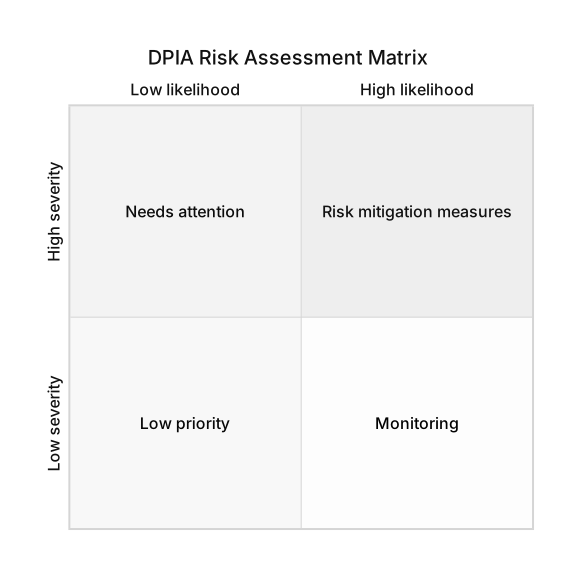
Each hypothetical scenario was evaluated across two dimensions:
- Severity of the consequences for the individual.
- Likelihood of it happening.
If the risk is high on both dimensions, we must implement mitigation measures.

“Anxiety brainstorming”: what scenarios we found
Whenever we run a DPIA, our team turns into a group of professional “worriers” to anticipate every negative user scenario tied to each processing activity.
In this project, one of the most visible risk points was the leaderboard: it displayed users’ nicknames alongside winnings. This information was shown on the main page and was accessible to all users. To understand the impact, we asked: “Who can see these nicknames? What might happen to the person as a result?” and generated around 15 different scenarios for this single activity. Here are a few:
🔹 If a player is Muslim and their nickname (e.g., Muhammad) appears on the leaderboard, it could lead to serious condemnation within their community, because gambling is prohibited in Islam.
🔹 A player’s employer or partner may learn about the gambling activity, which in the worst case could lead to dismissal or divorce.
🔹 Publishing a real name or an identifiable nickname next to a very large win can make the player a target for criminals.
🔹 If a politician or businessperson plays under their real name, this can lead to blackmail and reputational damage.
🔹 Third parties can scrape leaderboard data; as a result, players with addiction can end up in databases used by predatory lenders and other casinos.
🔹 Players may use someone else’s name as a username and, by appearing on the leaderboard, compromise people who have no connection to online gambling.
🔹 Targeted advertising to online casino users can reinforce addiction.
And this is just one example. Beyond the leaderboard, we analyzed internal systems as well: how resilient are they to external threats? Can employees export a database of players?
After identifying 31 risk scenarios, we needed to assess how serious the impact could be for users and which steps would allow the client to reduce these risks.
We’ll help you identify even the least obvious risks in your processing activities
Book a free consultation with our expert. We’ll discuss your product and operating regions, highlight where risks may exist for users and for the business, and outline practical steps to mitigate them.
What did the client get in the end?
As a result of the extensive brainstorming, we created a large table that captured:
🔹 potential threats,
🔹 possible consequences,
🔹 severity and likelihood before any measures,
🔹 mitigation measures,
🔹 severity and likelihood after the measures.
Conducting a full DPIA of the entire system allowed us to classify risks and make strategic decisions:
1) Stop practices that should be abandoned completely.
We helped the client identify which ways of displaying data, analytics tools, and employee access levels were excessive and created unjustifiably high risk.
2) Reduce risks associated with necessary practices.
We developed a list of measures to make existing processes less invasive to users’ privacy, including: masking usernames, generating random nicknames at registration, and a mechanism for guaranteed account deletion.
One row of the risk table looked like this:

Scenario | Impact | Severity (before) | Likelihood (before) | Mitigation measures | Severity (after) | Likelihood (after) |
|---|---|---|---|---|---|---|
Addiction worsening due to targeted advertising for casino/betting services | • Financial difficulties that are not necessarily permanent (e.g., needing to take a loan); • Loss of housing. | • Significant; • Significant. | Significant | • Review regulatory approaches to dark patterns in gambling interfaces and limit deceptive patterns; • Prohibit targeted advertising to vulnerable groups. | Limited | Significant |
Conclusion
This case shows that high-quality GDPR compliance is not a “checkbox” for regulators — it is real protection for users against unpredictable life situations. Our expertise helps us see risks where others see only a line of code. Details matter: sometimes your client’s security depends on how quickly you “switch on the anxiety”.
Make your business safer with DPO Europe
Book a free consultation with an expert. We’ll assess your current data protection posture, identify gaps, and propose a plan to address them.
Other DPO Europe projects



- AI/ML
- Enterprise


We help enter new markets and be compliant in current ones

Sign up for a free consultation with our expert to assess the current compliance level of your international project and learn how to improve it.

 2. Code section