

What GDPR Documentation Company Needs
- 13.01.2026
- Business, Data Privacy, Top articles
When a company enters the European market or begins working with personal data in a more structured way, a logical question arises: what documents for personal data protection under General Data Protection Regulation are actually needed, and why spend time on them? In this article, we’ll examine which documents are critically important, which ones complement the personal data protection system, and how to create them so they work in practice. If you’re a beginning privacy specialist or a startup that wants to avoid mistakes, this material will help you set priorities.
Table of Contents
Why Are Documents Needed under EU GDPR?
When a company first encounters GDPR documentation requirements documents, the reaction is often the same: a sigh, a desire to download a template from the internet and get this topic out of sight. It seems like a formality — a set of files that no one will ever read. But in reality, personal data protection documentation works quite differently.
1) It’s a tool of proof. In Europe, the principle of accountability applies: if a company cannot show that it complies with GDPR requirements, the supervisory authority considers it to be in violation. Conversely, if a personal data incident occurs in a company but it has a register and described response procedures, the supervisory authority will limit itself to a milder penalty or warning.
2) Documents help the business itself understand what’s happening with data. Some companies discover unexpected things already at the stage of compiling RoPA: for example, that a marketing intern has access to the user database, or that data has been stored “temporarily” for three years already. After formalizing processes, the team begins to respond to user requests faster, reduces the volume of stored data, and saves resources.
3) A quality privacy policy and clear procedures increase customer trust. For a new product in the European market, this can become a real competitive advantage: transparency in handling data is perceived as a sign of business maturity and reliability. For clients in Europe, this is truly important: GDPR has already “taken root” for them, and its compliance is already considered the baseline minimum.
Mandatory GDPR Documentation
When a company or startup decides to enter the European market, the documentation question suddenly becomes very voluminous. It seems that around GDPR there exists an endless list of requirements, and each source adds something of its own: “create a RoPA“, “urgently need a cookie policy“, “conduct a DPIA“, “sign DPAs with all contractors“. At this stage, it’s easy to get lost. But if you look deeper, it becomes clear: several key documents form the foundation of the entire personal data protection system and help the company operate safely, predictably, and legally.
Record of Processing Activities (RoPA)
The Record of Processing Activities under Article 30 of the GDPR is, essentially, a map of what happens with data inside the organization. It is during the compilation of the register that an understanding of the scale of processing in the company is formed.
RoPA shows:
-
- what data is collected,
- why it’s done,
- on what legal basis,
- where and to whom data is transferred,
- how long it’s stored.
GDPR requires not just compiling such a document, but maintaining it in an up-to-date state. This is an important feature: RoPA is a living tool that the company refers to during audits, when responding to user requests, when preparing the privacy policy, and when analyzing risks. If a supervisory authority requests information and the company cannot promptly provide it, this is perceived as a lack of control.
Article: AI for DPO: Record of Processing Activities Fill Case Study

Privacy Policy
The privacy policy is the first document that a user sees. It reflects the requirements of Articles 12, 13, and 14 GDPR and determines how transparently the company explains:
-
- what it does with data,
- on what legal basis,
- what rights the user has.
In practice, a common mistake occurs: the company copies the policy from a competitor or takes the first template from the internet. As a result, the document contains phrases like “we may transfer data to third parties“, but doesn’t disclose who these parties are, why they need the data, and what protection mechanisms are applied.
A distinctive feature of the privacy policy is that it must be understandable to an ordinary user. This is directly stated in Article 12 GDPR. Sometimes this requires visualization, FAQs, reduction of legal formulations. The simpler the text, the higher the trust.
Cookie Policy
If a product uses analytics, advertising, or trackers—almost always a separate cookie policy and correct cookie banner are necessary. GDPR in combination with ePrivacy requires obtaining consent for the use of non-essential cookies. In practice, this means that before consent, the user should not receive marketing or analytical cookies.
But having a cookie banner is not enough. It must allow the data subject (that is, the website user) to exercise their rights. The banner should not contain only an “Accept” button or make it more prominent compared to others: “Reject” or “Customize preferences“.
Video Surveillance Policy
If a company conducts video surveillance, for example, in an office or warehouse, there arises a need to document the rules for processing video recording data. The Regulation doesn’t directly require a separate policy, but Article 35 establishes the mandatory conduct of a Data Protection Impact Assessment for processing operations that may create high risk, and video surveillance often falls into this category.
The distinctive feature of video data is that it can contain sensitive information about people’s behavior, their movements, emotional state.
DPIA (Data Privacy Impact Assessment)
Data Privacy Impact Assessment, provided for in Article 35 GDPR, is one of the most undervalued tools. It helps identify risks to the data subjects and freedoms of people, not just to the business.
DPIA is especially important if:
-
- medical or financial data is used,
- monitoring of the data subjects is conducted,
- geolocation is collected,
- profiling is applied.
In our practice, there was a case: an entertainment industry company displayed the names and usernames of top players on the main screen of the application along with the time of their last game. Consultants realized that the original purpose of this mechanism — to show the game’s popularity — was incompatible with the extra risk of identifying these users. The company was advised to mask usernames or generate random ones for this purpose altogether.
Cross-Border Data Transfers: SCC and TIA
If you transfer personal data outside of the european economic area, for example to the USA, the company requires a mechanism to ensure adequate protection. The most common option is Standard Contractual Clauses (SCC) approved by the European Commission.
SCCs cannot be modified — this is their key feature. Companies can additionally agree on audit procedures or distribution of responsibilities, but the basic text remains unchanged.
After the Schrems II decision, it became mandatory to conduct a Transfer Impact Assessment (TIA) to assess whether the recipient country provides a level of protection comparable to the European one. For companies using American services, this is critically important: a European partner may well suspend processing of personal data until the assessment is provided.
Legitimate Interest Assessment
If processing is based on Article 6 GDPR—”legitimate interest“, the company is obliged to document its existence. Legitimate Interest Assessment helps demonstrate:
-
- why the company needs the processing,
- whether it is necessary,
- whether it violates the data subject’s rights.
For example, sending users product updates may be justified by legitimate interest, but marketing mailings without consent are not. LIA allows conducting a balance of interests and determining protection measures: the ability to unsubscribe, limitation of data volume, transparent information.
Data Processing Agreement
If a company transfers data to a contractor — a developer, marketing agency, hosting provider — Article 28 GDPR requires concluding a Data Processing Agreement. It specifies the obligations of data processor:
-
- protect data,
- notify about incidents,
- not engage sub-contractors without consent,
- apply technical and organizational measures.
In practice, a situation often occurs when a startup uses a freelancer and gives them access to the user database without a contract. In case of a personal data breach, responsibility remains with the data controller, and the absence of a DPA only strengthens the regulator’s position.
Security Procedures: Data Breach, Access, and Data Subject Requests
GDPR establishes the obligation to respond to incidents and ensure the rights of data subjects. Therefore, documents are important that describe:
-
- how employees should act in case of a data breach,
- whom to notify,
- how to revoke data access,
- how to process user requests.
Articles 15–21 GDPR establish the rights of data subjects, and companies must be able to respond to requests within one month. Without documented procedures, the business risks missing deadlines or providing incomplete information. And this is already a violation.
Access policy also plays a huge role. If a former employee retains access to the admin panel or corporate email, the risk of leakage becomes very high. A document that describes the process of granting and revoking access helps structure this process and regularly check it.
Ultimately, these documents form the core of GDPR compliance. They allow the company to understand its processes, demonstrate compliance, reduce risks, and build trusting relationships with users and partners. And although working on them may seem laborious, the practical effect often manifests already in the first months: processes become clearer, data more structured, and the business more resilient.
Want to learn how to build robust documentation under GDPR?
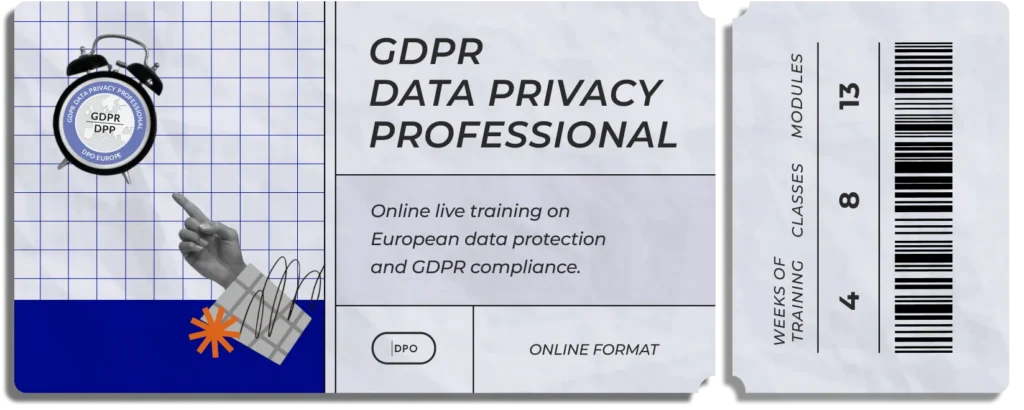
Join our GDPR Data Privacy Professional course. Whether you’re navigating RoPA, DPIAs, or cross-border transfers, this course gives you the tools to turn legal requirement into operational excellence.
Other GDPR Documents
When a company has already passed the first stage of GDPR implementation — created basic documents like RoPA, privacy policy, DPA — there appears a feeling that the hardest part is behind. But in practice, it is precisely the following documents that determine how well the personal data protection system will work daily, not just on paper.
It’s important to understand: most of them are not named in GDPR directly. However, they grow out of key principles — accountability, transparency, storage limitation, and ensuring security (Article 5 GDPR). And if a supervisory authority comes for an inspection, these documents will most often become proof that the company actually manages data processing, rather than simply declaring intentions.
Let’s examine each of them separately.
Data Sharing Agreement
This document is needed when a company transfers data to an independent controller — that is, a party that determines for itself why and how it will use the data. Example: a marketplace transfers information about a seller to a bank for identity verification. The bank does not carry out the marketplace’s instructions; it acts as an independent controller.
DSA helps describe:
-
- why data is transferred,
- what data is transferred,
- who does what when data subjects make requests.
It is linked to transparency requirements (Art. 13–14 GDPR) and accountability (Art. 5(2) GDPR). Imagine a situation: a company transferred data to a partner without formalizing an agreement, and then couldn’t fulfill a deletion request because the partner refused to delete records. DSA prevents precisely such cases.
Joint Controllership Agreement
Joint control arises more often than it seems. For example, if a company and its partner jointly determine the purposes of data processing — as happens with joint marketing or the operation of a platform and sellers.
GDPR requires formalizing such relationships and establishing the roles and responsibilities of the parties. Without this, in the event of an incident, data subjects can make claims against both parties, and it will be difficult to prove the boundaries of responsibility.
Terms of Use
All users know this document, but few understand its role in GDPR. If data processing is based on a contract (Art. 6 GDPR), the terms of use help define the framework of obligations.
For example, a SaaS service is obliged to provide access to the product, and the user must provide data necessary for registration. If the terms are formulated vaguely, the company risks going beyond the “contract” and ending up in the zone of consent requirements.
Retention Policy
The principle of storage limitation (Art. 5(1)(e) GDPR) requires not storing data “just in case“. But without a formal document, companies rarely understand:
-
- what data they have,
- how long it’s stored,
- when and how to delete it.
In our practice, there’s a case where such excessive data retention was disadvantageous to the company even from a cost perspective. It stored a list of email subscribers for five years, although half the addresses were inactive. After implementing a Data Retention Policy, the database was cut in half, and costs for data storage on the server and mailings significantly decreased.
Information Security Policy
This is the foundation of all technical and organizational measures. It describes:
-
- who is responsible for security,
- how access is granted,
- what devices are permitted,
- how incidents are prevented and handled.
Regulators often request precisely this document when verifying compliance with the principle of integrity and confidentiality (Art. 5(1)(f)). Without it, a company cannot prove a systematic approach to data protection.
Mobile Device Usage Rules
When employees use personal phones or laptops for work (BYOD model), risks increase dramatically. A lost phone with access to corporate email can become a source of leakage.
This document describes:
-
- device requirements,
- mandatory password protection,
- encryption,
- prohibition on storing data locally.
The absence of BYOD rules can work against a company when an employee downloads a client database onto a personal laptop “to work on the weekend“, and it gets stolen or hacked.
Rules for Processing Personal Data During Remote Work
Remote work has become the standard, but not all companies have adapted their processes. This document helps implement:
-
- VPN,
- two-factor authentication,
- requirements for home Wi-Fi networks,
- prohibition on using public networks.
A leak can even be related to working in a café using a connection to a publicly accessible Wi-Fi point. Such points may be insufficiently protected, and traffic can be intercepted by attackers.
Document on Internal Audits by the DPO
GDPR requires demonstrating compliance, not simply asserting it. Therefore, regular checks become a mandatory element of accountability (Art. 5(2)).
The document establishes:
-
- how often an audit is conducted,
- who participates,
- how results are documented.
A critically important feature: each check must conclude with an action plan. In many companies, checks turn into a formality, and this document helps avoid “paper compliance“.
Procedure for Maintaining and Updating RoPA
Art. 30 GDPR requires a current register of processing activities. But in reality, RoPA is often created once — and forgotten.
This document establishes:
-
- who is responsible for updating,
- how changes are recorded,
- how new processing activities are entered.
During inspections, supervisory authorities often compare actual processes and RoPA. If the register is outdated, this is perceived as a lack of control, even if the processes generally exist.
Procedure for Training and Testing Employee Knowledge
GDPR compliance is impossible without people’s participation. Most leaks occur due to employee errors: phishing emails, incorrect access settings, file forwarding.
This document defines:
-
- how training is conducted,
- how participation is recorded,
- how knowledge is tested.
Regular training minimizes the risk that an employee themselves will become a source of risk.
Procedure for Disposing of Information Carriers
Even the strictest security policy won’t help if an old hard drive with data ends up at a flea market. This document describes:
-
- how physical media are destroyed,
- how data is deleted before transferring equipment,
- what methods are used.
It is linked to the principles of storage limitation and confidentiality (Art. 5(1)(e),(f)). If a company sells laptops to former employees without wiping the drives, client data ends up in the open. The disposal procedure document prevents precisely such incidents.
These documents form the “operational core” of GDPR. They prove that a company hasn’t simply written a privacy policy, but actually manages data processing: controls access, trains employees, deletes outdated data, and regulates relationships with partners. It’s precisely the presence of such procedures that most often convinces regulators and clients that a business is mature, responsible, and deserves trust.
How to Create Documents for Regulation Compliance: 7 Tips
Start Not with Text, but with Processes
The most common business mistake is trying to immediately write a policy or agreement. But a document should describe what is already working, or launch a process that will be implemented. Therefore, the first step should always be strategy: how the company will build a personal data protection system and what resources it can allocate to this.
Good practice is to start with data and business process inventory. Until you yourself know what processes are happening inside, it’s impossible to create correct documents.
A useful tool is Data Flow Mapping — a diagram showing how data passes through systems. Based on it, RoPA, retention policy, DPA, and security processes are formed.
Focus on Risk
GDPR recognizes that achieving absolute compliance is impossible. Therefore, when developing documents, it’s important to prioritize: first — processing with high risk, then everything else.
Companies that try to “do everything at once” often spend resources on secondary documents, forgetting about critical processes. It’s much more effective to ask questions:
-
- where is our most sensitive data?
- who has access to it?
- what risks are most likely?
And based on this, determine the development sequence.
Make Documents Understandable
Article 12 GDPR requires that public documents be understandable to an ordinary person. This sounds simple, but in practice many policies and procedures look like dry legal texts: long sentences, complex constructions, terms without explanations.
A user who has read such a policy will not feel trust. And most likely, they won’t even take on reading it.
Therefore, it’s important to:
-
- write in simple “human” language,
- structure information,
- use visual elements, hints,
- adapt the document to the audience.
If a document is understandable, it’s a sign of maturity of the personal data protection system.
Make Documents Unique and Keep Them Current
One of the most harmful practices is copying documents from competitors. In addition to obvious risks (others’ errors, inconsistency with processes), there are also curious cases: for example, when a small SaaS company’s policy has a section on video surveillance at production facilities, although it had neither an office nor cameras.
Documents must reflect:
-
- real processes,
- specific systems,
- specific risks.
And they must be constantly updated. The process of updating RoPA, policies, or procedures must be formalized. If a company implements a new CRM or starts working with a new contractor, documents must change.
Regulators very quickly notice discrepancies between documents and reality. And this most often leads to claims.
Describe the Real Security Measures That Exist in the Company
Companies sometimes create an impression of security “on paper,” but upon inspection it turns out that technical measures have not been implemented. For example, a policy prohibits storing data locally, but employees continue downloading databases to laptops.
Therefore, when developing documents, it’s important to ask specific questions:
-
- where is data physically stored?
- who has access to the servers?
- where do developers and support work?
- what infrastructure is used?
Documents must describe real measures; otherwise, they turn into risks.
Involve Employees
GDPR is impossible through the efforts of a single DPO or lawyer alone. If employees don’t understand why it’s being done, delays, sabotage, and errors arise. Therefore, part of the documentation should be aimed at training and informing: instructions, rules, response processes.
Companies that explain privacy goals usually implement changes faster and encounter incidents less frequently.
How Does Professional Document Development Work?
Our team at Data Privacy Office Europe begins work not with templates, but with process analysis: we conduct interviews with process owners, audit existing practices, and assess real risks. After this, an implementation strategy is created, and only then documents.
Developing GDPR documents is truly similar to creating an architectural project. You can’t simply take someone else’s blueprint and hope it will fit. First, you need to study the “terrain” — processes and risks, then develop a strategy, and only after that create documentation that will work in reality. This approach not only helps comply with the GDPR, but also makes the business more resilient, secure, and attractive to clients and partners.
Understanding which documents are truly important and how to create them properly allows you to avoid overloading the business with bureaucracy while simultaneously meeting legislative requirements. The next step is to conduct an inventory of data and processes, determine priorities, and begin building documentation, starting with key documents. As the business develops, documents must be updated and adapted to changes. If you approach this systematically, documentation becomes not a burdensome obligation, but a working tool that strengthens the company and helps it grow safely.
Personal Data Protection Help and Support under GDPR and National Laws
We help establish systematic personal data protection practices through training and consulting services.
Consulting services on data privacy according to GDPR, ISO 27701 and other international standards.
EU Representative Services under GDPR is a pay-as-you-go service where representation is free during periods without data subject requests or communication with supervisory authorities. The service remains free if the company has not significantly altered its data processing practices since its onboarding process.
A fundamental course that covers all aspects of GDPR and teaches how to apply them in practice.
Privacy training programs for teams both in live online and e-learning formats with diverse level of depth. Customizable and interactive solution for fair price.









Reach Data Privacy & AI Compliance

Fill in the form and get a free consultation.
- Implementation of 7+ legal frameworks.
- Individual and corporate training on the GDPR, and international standards.
- Development of personal data protection systems within organizations.
- Custom services upon request.